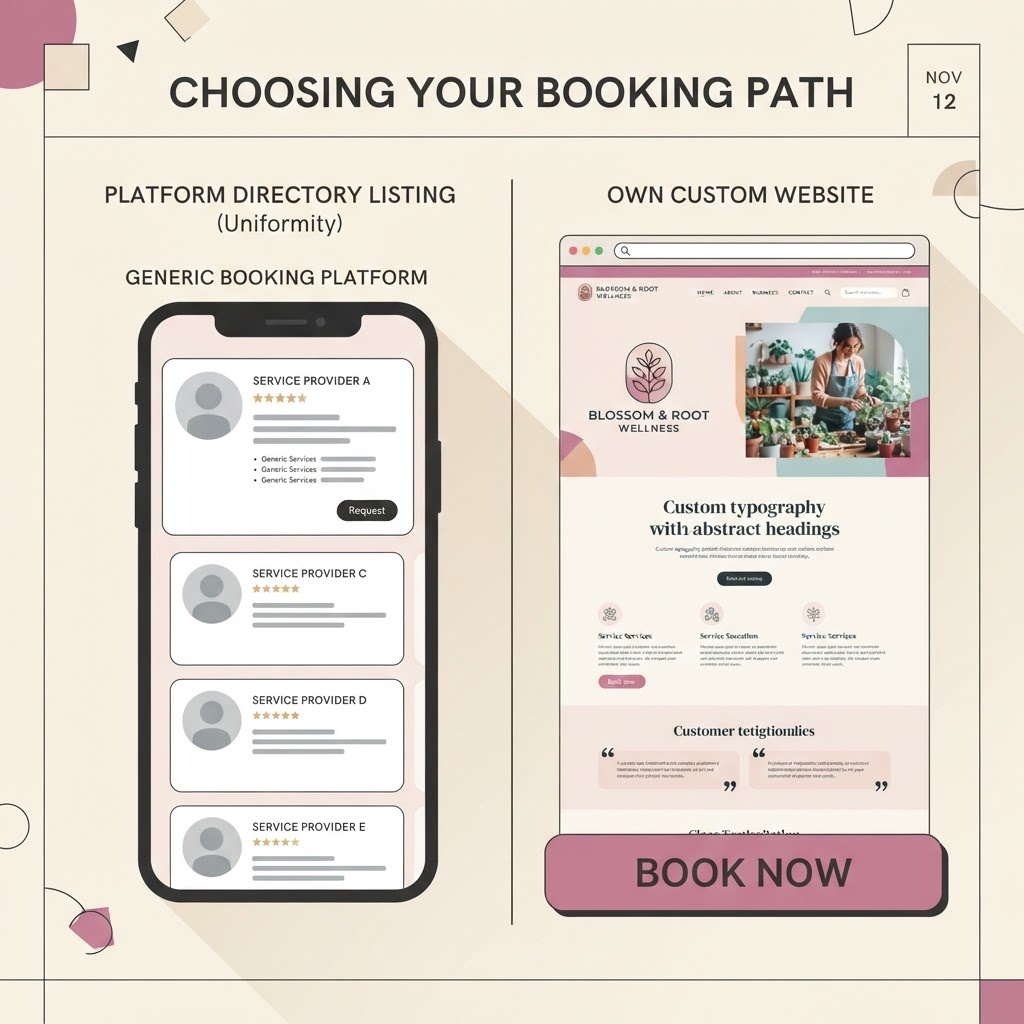
When someone finds your business online, they're making a split-second judgment about you. And a big part of that judgment comes down to what they land on: your own website, or a page on a booking platform like Gloss Genius, Vagaro, Square Appointments, or Fresha.
These booking platforms are genuinely useful tools. They handle scheduling, deposits, automated reminders, and payments without you lifting a finger. But a booking page and a website are not the same thing, and a lot of service businesses are paying the price for treating them as interchangeable.
Let's break down what each one actually is, where the differences show up, and why the strongest businesses usually use both — with a website doing the heavy lifting.
What a Booking Site Actually Is
Platforms like Gloss Genius, Vagaro, Fresha, StyleSeat, and Square Appointments give you a hosted page where clients can:
- Browse your services and prices
- Book appointments and pay deposits
- Message you and see your hours and location
- Leave reviews (on some platforms)
Setup takes an afternoon and the monthly cost is usually modest, which is exactly why they're so popular with solo stylists, lash artists, cleaners, tutors, and other service pros.
But here's the important part: you don't own that page. You're renting space on the platform's domain, inside the platform's design system, subject to the platform's rules and fees. That single fact drives almost every difference below.
What a Real Website Actually Is
Your own website — on your own domain, like yourbusiness.com — is the property you control. It can:
- Present your brand exactly the way you want
- Rank on Google for the searches your clients are actually typing
- Educate, convert, and pre-sell before anyone books
- Grow and change with your business
A website is the difference between being listed somewhere online and having a real online presence.
The Seven Differences That Actually Matter
1. Ranking on Google
This is the big one. Booking platform pages rank poorly for your services — and sometimes they rank worse than nothing.
Here's why: a page like glossgenius.com/yourbusiness is sharing its "authority" (Google's measure of trust) with the whole platform, competing against thousands of other businesses. Google has very little reason to show your slice of it when someone searches "balayage specialist in Greenville" or "deep cleaning service near me."
Meanwhile, that same searcher is ready to book. Someone with their own website and service pages can capture them; someone with only a booking page usually can't. This is also true on AI search tools like ChatGPT and Google's AI Overviews — they recommend businesses they can read about on the open web, and a booking profile gives them almost nothing to read.
2. Your Brand vs. Their Brand
A booking page is a template. Your logo goes where the platform allows, your photos crop how the platform crops, and your business sits in a sidebar or feed next to your competitors.
Your website is the opposite: your colors, your voice, your story, your testimonials woven into the page. For a business where clients book based on vibe — salons, aesthetics, photography, wellness — that brand control isn't vanity. It's the conversion tool.
3. What Clients Can Learn About You
A booking page answers one question: "can I book?" It does a poor job answering:
- "What exactly is included in this service?"
- "What makes this person different from the five others I'm comparing?"
- "What do past clients say in detail?"
- "Do they understand my specific problem?"
A real website answers all of those with dedicated service pages, an about page that builds trust, a portfolio, detailed FAQs, and blog posts that show expertise. Clients who arrive at your site pre-convinced book faster, hesitate less, and are better clients overall.
4. Fees and Fine Print
Booking platforms monetize in different ways — booking commissions, payment processing markups, mandatory "free trial" funnels that convert to subscriptions, and charges for features that should be basic. None of it is outrageous in isolation, but it adds up, and the terms can change underneath you.
Your website has a fixed, predictable cost (hosting plus your builder or designer) and the payment processing you already use. You also keep the client relationship: their email, their phone number, their booking history, your reminder cadence, your policies. On a platform, you're working within their relationship with your client.
5. Ownership and Portability
If you build your business on Gloss Genius and later outgrow it, you can't take the page with you. Your reviews, your gallery, your content — some of it exports, some of it doesn't, and your Google ranking (such as it is) resets to zero.
A website is an asset. It appreciates: every blog post, every service page, every backlink keeps paying you. You can redesign it, move it, expand it — the domain and its authority come with you.
6. The Directory Effect
Here's the trap most people miss: booking platforms are directories wearing a website costume. When a client searches "lash tech near me," the platform is designed to show them multiple nearby options — you, and everyone like you.
That's great for the platform. For you, it means you're competing inside a list where the main differentiator is often a photo and a price. On your own website, there is no list. There's only you.
7. Marketing and Data
Your own website plays nicely with everything else: Google Business Profile links, Instagram bios, email capture, analytics, remarketing, SEO content. You can see exactly which pages bring in bookings and double down.
Booking platforms give you their in-app stats — useful, but a closed loop. You can't easily combine them with Google Analytics, run content strategies off them, or build an email list the way you can on your own site.
So Are Booking Sites Bad?
No — and this is where a lot of advice goes wrong. Booking platforms solve a real problem. The scheduling, deposits, reminders, and payment infrastructure are genuinely excellent, and building all of that yourself is expensive.
The mistake isn't using Gloss Genius or Vagaro. The mistake is treating it as your entire online presence.
The Playbook: Both, Each Doing Its Job
The strongest setup for a service business looks like this:
- Your website is the front door. It ranks on Google, tells your story, and educates clients. Every service gets its own page; your reviews live here; your blog answers the questions clients actually search.
- The booking platform is the back office. Your website's "Book Now" button links to your Gloss Genius / Vagaro / Square page, or an embedded scheduler. You get platform-grade scheduling without giving up your Google presence.
- Your Google Business Profile ties it together. It links to your website, collects reviews, and posts updates weekly — the reviews and posts build the local trust signals that neither the booking page nor the website can build alone.
This way you get the SEO and brand benefits of a real website and the operational convenience of a booking platform. Clients find you on Google, land on your site, get sold, then book through the tool that handles it well.
What This Looks Like in Practice
A lash artist on our approach: her site has a homepage, a page for each service (classic sets, volumes, refills) with real pricing and aftercare info, a gallery, reviews, and a blog answering questions like "how long do lash extensions last." Her "Book Now" buttons go to her booking platform for scheduling and deposits. When someone searches "volume lashes Greenville," she ranks — her booking page never would have.
A cleaning company: their site has pages for each service (residential, move-out, deep clean) plus a quote form, and uses their booking tool for confirmation and payment. Same pattern, same result.
The Bottom Line
A booking site is a tool. A website is an asset. The tool books the appointment; the asset brings the client to the door in the first place.
If you're only on a booking platform today, you're invisible to the biggest source of new clients there is — people searching Google for exactly what you do. And if you're a business owner who's been told "you don't need a website anymore," you were told by someone selling you a booking page.
Use both. Let the platform run your calendar and let your website win the search.
Wondering what a website that actually ranks would cost — or what it would include? That's exactly what we build. Explore our packages and pricing or take a look at our recent work.